

The P-block project has reached a major milestone: the deployment of the monitors in the building. It is now crucial to clarify how we will manage and use all the data we will measure in the building. To understand how it improves our experience for building occupants and managers we sat down with two of our project members, PhD Candidate Bingnan Zhao and Research Fellow Dr. Tharindu Warnakulasuriya from the AI team.
Office buildings have complex systems working in the background to keep us all comfortable. This includes an array of sensors, wired or wireless that collect a plethora of data, such as temperature, light, and humidity. These sensors send these data to the central system, called the Building Management System (BMS). The BMS may then modify parameters like the temperature, humidity, light and security, among others.
Currently, the BMS control relies mainly on predefined schedules, set points and manual adjustment by building engineers. As Mr. Zhao explained, ‘Adjusting the control strategy is slow and labour-intensive, and it’s genuinely hard for a person to balance energy savings against air quality by hand.’
For example, bringing more outdoor air into a building can improve ventilation and reduce indoor pollutant concentrations, but that air may need to be filtered, heated or cooled. This creates a trade-off between indoor air quality, occupant comfort and energy use. But what if the space is unoccupied, so that changing the temperature is unnecessary? Or, what if the air from outside isn’t clean? AI optimisation of the HVAC (heating, ventilation and air conditioning) system creates a path forward to better manage this trade-off.
This is why, as part of the P-block project, we aim to use AI to optimise how the BMS controls all these parameters more efficiently, as explained by Mr. Zhao, ‘The bottleneck we’re addressing is in how the building is currently controlled’.
The AI team are developing software systems that act as decision makers, called agents. As Dr. Warnakulasuriya puts it, ‘An AI agent can learn from experience and continuously search for better control strategies on its own, adapting as conditions change rather than waiting for a scheduled review.’
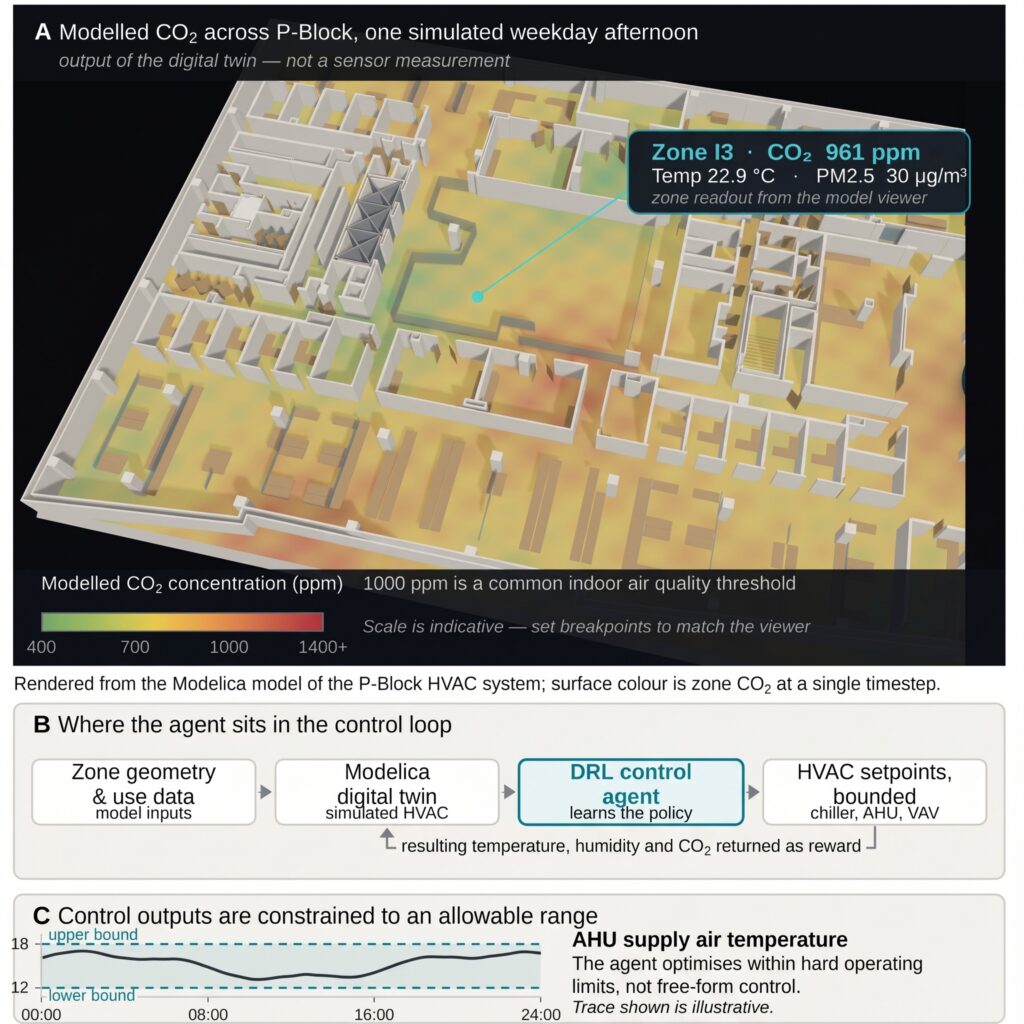
Figure 1. Illustration of the IA-based system developed for the P-block project A) Modelled CO2 concentrations across P-Block output from the Digital Twin; (B) Control loop process showing position of the AI agent; C) Hard limits on control outputs for the supply air temperature.
Safety is essential: errors by the AI-based system could harm the building’s occupants. At this stage, the agents are working on a Digital Twin of the P-block system, with hard operating boundaries and no live connection to the BMS. According to Dr. Warnakulasuriya, ‘Within the simulation environment we’ve already built in action boundaries, so the agent’s HVAC control outputs remain within predefined operating limits’.
We expect this new approach will reduce operational costs, improve environmental outcomes for building occupants and provide more efficient energy use (~7% in previous simulations across level 8). As Mr. Zhao explained, ‘We’re evaluating the agent against the existing schedule-based control on four metrics: time taken to reach target temperature, time taken to reach target CO2 levels, time taken to reach target humidity, and overall energy consumption compared to the baseline.’
Work will continue on training and development of the model with security and safety in mind. Data will become available in the coming months, and more information can be found on the P-block website.
The full Q&A will be posted in the coming weeks
By Alicia Josa-Cullere & Hamesh Patel